Monday, January 7, 2013

Be Satisfied. Be Grateful. Be Giving

I've noticed that recently I have really had a thing for Jewish Authors. I loved Viktor Frankl's Man's Search for Meaning, and Will to Meaning, as well as his Man's Search for Ultimate Meaning. I recently read Harold Kushner's How Good Do We Have to Be? I'll read most anything by Martin Buber. I just really like these books. I realized how many of them I have been reading when I finished another book by a Jewish writer. Mitch Albom's Have a Little Faith.

I loved the book. It was a Christmas present to me from my future in-laws who enjoyed it and know I love to read. I own a copy of Mitch Albom's Tuesdays With Morrie but I've never read it. I intend to do that soon because I really like his writing. In Have a Little Faith Mitch is gives chronicles meetings with his rabbi, Albert Lewis. Mitch is preparing a eulogy for the eventual death of the rabbi and meets with him frequently to prepare.

I love the story and the fact that it's true. I really learned a lot and enjoyed Mitch's conversations with his spiritual leader. One story I liked in particular. Mitch asks the rabbi "What makes a man happy?" and his rabbi answers saying, "The thing's society tells us we must have to be happy- a new this or that, a bigger house, a better job. I know the falsity of it. I have counseled many people who have all these things, and I can tell you that they are not happy because of them.
         "The number of marriages that have disintegrated when they had all the stuff in the world. The families who fought and argued all the time, when they had money and health. Having more does not keep you from  wanting more. And if you always want more-to be richer, more beautiful, more well known-you are missing the bigger picture, and I can tell you from experience, happiness will never come."
          They are interrupted by a baby crying in the hospital and the rabbi says, "Now, that child reminds me of something our sages taught. When a baby comes into the world, its hands are clenched right? Why?  Because a baby, not knowing any better, wants to grab everything, to say, 'The whole world is mine'
          "But when an old person dies, how does he do so? With his hands open. Why? Because he has learned the lesson. We can take nothing with us." 

I think this story shows where we can find true happiness. We cannot become happy by amassing things. In fact, as Viktor Frankl says, perhaps our quest for happiness is the very thing keeping us from true joy. If we focus on receiving things and being happy ourselves we are missing the true point. I don't believe happiness is the end goal. I think it is the by product of a life well lived. It comes from thinking of others and helping. Not by taking and getting, but by letting go and giving.

Mitch Albom continues the conversation between him and Lewis.

So, have we solved the secret of happiness?
"I believe so," he [the rabbi] said.
Are you going to tell me?
"Yes. Ready?"
Ready.
"Be satisfied."
That's it?
"Be grateful."
That's it?
"For what you have. For the love you receive. And what God has given you."
That's it?
He looked me in the eye. Then he sighed deeply.
"That's it."

Be satisfied, be grateful, and I would add, be giving.

Saturday, January 5, 2013

Hospital Horror

To preface this post I want to say that I don't like scare tactics. I try to make people aware, without trying to go for the shock factor. I try to say it how it is or how I see it and if people feel inclined to help it is much appreciated. This post I want to talk about hospitals in Romania and help people know why it is important to get the orphans out of institutions and into better situations. This is linking to my little series of posts on the situation for some people in Romania. My experiences are as follows:


Trivale Forest
Romania is a beautiful place and I was blessed to see most of it.  I spent some time living in Sibiu, a city in Romania that won the European Cultural Capital award in 2007 and it is gorgeous. I love Trivale Forest in Pitesti. Castles and churches are everywhere.  Casa Poporului in Bucharest is a large monumental architectural masterpiece. The most impressive place I got to visit was on a drive along the Transfăgărășan road up in the Carpathian Mountains connecting Transylvania and Wallachia. I described it to my family as the emerald, beating, beautiful heart of a wondrous land. Romania is a magnificent place full of lovely people. I look back to my memories and it seems celestial.


Transfăgărășan
Casa Poporului 

But there is opposition in all things.

Daily was my life heaven on earth. However, there were places where it seemed that if there was a hell on earth I had found it. I found it in the Romanian hospitals. I remember my first visit to one. I had been living in the country for just a few months. The teenage boy of a family we knew got sick and had to spend three days in the hospital. We were asked to visit him and bring along some groceries. This confused me. After we bought some bread and fruit we walked to the hospital. Three nurses, dressed in scrubs and sneers, were seated on the steps outside smoking. We walked inside and it was chaos. The only light in the hallways came from the windows because all the electric lighting was turned off. People were milling around and we couldn't find our way to the boy. After walking around the musty dark maze of hallways we finally found his room.

I now understood the reason for groceries; if we didn't bring food to him he wouldn't get any. The hospital didn't provide food. All they seemed to have provided was a small dingy bed in a small room with seven other beds crammed in, and seven other kids. I wondered, what would happen if there was no one to bring him food, or what if one of those kids had an infectious sickness? It would be so easy to make the other kids ill as well. Conditions were surprising and sad. I learned that the family had to bring food and sometimes they had to visit other hospitals or pharmacies to bring medicine because if the hospital didn't have it they wouldn't do anything to get it. They would wait to do their work until someone else brought what was needed. Even if the pharmacy was just across the street!

We visited, bringing food from the family, for three days, and each day the boy wore the same dirty pajamas,  which I later found out he had to bring himself because the hospital didn't provide clothing either. I felt dark and sad in that place. I didn't see how anyone could get better. The nurses were rude. Doctors were corrupt and condescending. The building was a ruin, and this was one of the better hospitals in the city.
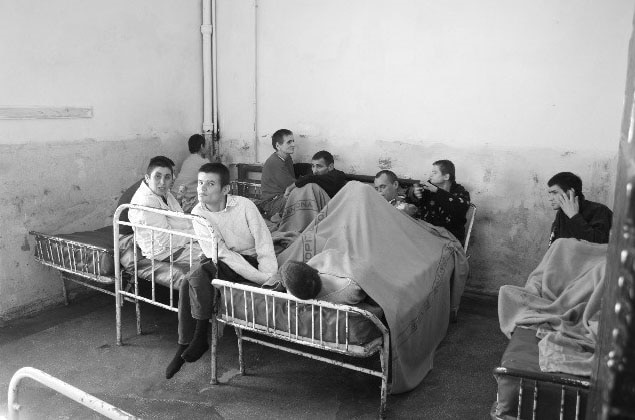
Similar situation of overcrowded hospital room
A few months later we were working with a man who suffered from severe alcoholism  I have never seen it so bad. Romania uses this blue 80% alcohol mixture for medical disinfectant purposes, but it isn't denatured like the USA version. It was basically cheap poison and this man drank up to four liters each day. His habit was so bad his wife and child had to live in another city to be safe. To make things worse he had a heart condition. This man should have been dead.

His life was a conundrum as well. As soon as he sober up he would just as quickly relapse and take a drink. With his first sip his life was a paradox. If he stopped drinking he would have withdrawals that would cause him to convulse so severely that it would overwork his weak heart and kill him. He would have to continue to drink to stave off the withdrawals and survive. The only way to get sober again was to get muscle relaxants in order to assuage the convulsions and keep his heart from working itself to death.

He lived right next door to a hospital. Sadly they wouldn't accept him into their doors. One night he was having problems and he called an ambulance to take him. The paramedics took him to the hospital where he was turned away. He had to walk, in his drunken condition, to anther hospital, where he was turned away once more. He was told to go to the mental institution so they could treat his alcoholism, because a normal hospital didn't do that kind of thing.

The next morning we got a call from him asking for us or one of his friends to bring him food and muscle relaxants (the hospital was running out and needed us to get more for him. Yes, there was a pharmacy right across the street again). We got some friends of his together and went to visit him and see how he was doing.

You know how in scary movies or video games they have hospitals will dark long corridors, flickering florescent lights, and patients in tattered hospital gowns wandering around with blank stares. That is what the mental institution was like. It felt like straight out of a horror movie and I hated it. I felt dark and frightened.

We entered the doors (above which a sign should have hung saying "Abandon all hope ye who enter in") and to our left was the nurses break room  It was full of doctors and nurses smoking and watching a soap opera on a little television. We interrupted their TV show and asked where our friend was. Once they finished killing us with their eyes for being so presumptuous and inconveniencing they told us to go find him ourselves and gave rough directions to where he was and turned back to their show. Thanking them we walked towards the back of the hospital.

A long corridor with locked doors lining it. A man in a contorted position sat in a wheelchair. A patient paced anxiously, scratching his head and talking angrily to himself as he smoked a cigarette  A lady shuffled past us, eyes staring straight ahead, oblivious to the drool running from her mouth down her neck and soaking her gown. It may have been my terrified imagination or reality but I swear I heard groans and moans coming from the locked doors.

We found our friend and asked how he was doing. Candidly the environment was great because he wanted to do anything he could to get out, even sober up for once. He was becoming depressed and just wanted to leave. The other patient in the room, a very old man, noticed my missionary name-tag I had on. He assumed I was a hospital worked and began to plead to be let out. "I don't belong here" he said, "I'm well, let me go, please. I'm better, I hate it here, please won't you let me go?" His begging started out pathetic, then became angry, and turned hysterical. It echoed loudly through the dingy hallways of the hospital. After 20 long minutes of it two orderlies burst through the door. The patient's supplications became screams as the orderlies roughly strapped him to his bed, pulled out a needle and poured a sedative into him. A few seconds later the man lay still and the orderlies left. We all looked at each other and decided we should leave too. We finished talking, set a time to meet the next day and left that awful place.

The next day we brought more food and some books for our friend to read. The other bed in his room was now empty. We asked where he was and our friend shuddered. The old man was dead. A mistake had been made and he was given too much sedative and it had killed him. I still don't know if the man had another outburst later on which required a second sedative or if he died when we were sitting three feet from him. I didn't ask, I didn't want to know. My friend was now even more anxious to leave.

I visited many more hospitals in my time in Romania, thankfully never as a patient. I saw better places, and I saw some just as bad or worse. The fact that these exist at all is tragic. The reason I share a few of my experiences is to illustrate how bad the institutions can be there. Orphanages can be just as bad as the hospitals. I hate to read articles about the conditions these children can be in. It is evident that these children need to be somewhere better. That's why Bridge of Love is there. That's why I'm happy to be helping. I hope I didn't frighten, but I want to show what its like, and that a change needs to be made.


Thursday, December 27, 2012

Longboard Helps: Which Helmet to Get?

A Viking helmet!
I actually don't reccomend
this for longboarding
Like I'm sure you've seen, I am a big advocate for helmets. If you are riding a board you are guaranteed to fall at some point in time. You need to be well protected. Thankfully if you break a wrist or an arm, your bones and muscles regenerate and heal. However, your brain cells don't regenerate like a broken bone do. Damage is often permanent. This may seems silly, but if our brain cells were always dying and regenerating, like skin cells or blood cells, you would be constantly forgetting and relearning things over and over. There is a method in this madness.

Since brain damages are permanent it is vital that we take care of it. In this post I want to talk about what to look for when purchasing a helmet. I am no authority on the subject and just got my information from reading and research. In the end the best thing you can do is read up on the subject and be safe.

As a younger person I didn't like to wear helmets. I thought they didn't look cool and were uncomfortable. It took a frightening crash and more information on helmets to convince me to wear one. I tried a few helmets but I ended up sticking with the basic Triple 8 Brainsaver. This is a nice helmet. It is great for simple skateboarding and longboarding. I love the terry-cloth liner inside and how comfortable it is. The model that I have, however, is not certified in any way. This means that I should not ride it on a bike, or at high speeds. It's perfect for the cruising and longboarding that I like to do. Especially good for a long distance trip.

Some of the best skateboard helmets are "dual-certified" to both the ASTM and CPSC standards. These provide much more protection for dangerous skating and bicycling.

But what does ASTM and CPSC mean? Well these are just tests that are run to see how well the helmets perform. A CSPS test is when they simulate a drop from 6 feet at a 14 mph impact. These kind of helmets are for bike riding. The ASTM test is a from from 3 feet at a 7 mph impact. ASTM helmets are made for skating. Helmets should be used for the proper activities and are not always guaranteed to prevent injury. But why take the chance without one.

In your quest for the right helmet you may hear about soft-foam or hard-foam helmets. This is just referring to the foam inside of the outer shell. This is what compresses as your head hits an object and helps slow down your head and reduce injury. A lot of helmets advertise as multiple impact, but, once again, why take the risk. After a bad crash or impact (and especially if you see damage to the helmet) you should throw it away and get another one. Small impacts you may be okay, but why gamble your brain on the $40 it takes to get a new helmet?

There are lots of different helmets out there and lots of good companies. Like I've mentioned before, my personal favorite, for the past 6 years, has been Triple 8. I like the design, and the comfort a lot. The helmets are quality and classy. Beyond the product itself Triple 8 is just a good company. I really like the forum they have where they take suggestions from people.

All that really matters though, is you get a helmet, and put it on your head when you ride. DO IT!


Monday, December 24, 2012

A Simple Christmas Gift

Christmas lights in Bucharest Romania
I've been thinking a lot about Christmas recently. Most especially when I was in Romania. Those where special Christmas times for me. My second Christmas I was in Sector Five of București. It was a frigid winter where we would walk outside and moisture would freeze to everything. Our coats, the fences, the trees, our faces, everything. As cold as this was it did look beautiful.

I was far away from my family and looking forward to talking to them on Skype come Christmas Day. The distance made it really hard for them to send me anything for Christmas so I wasn't really expecting anything. This was actually really liberating. I was away from all of the hustle and bustle of the season. Away from wanting gifts and things like that. It taught me that I don't really need things. All that matters are relationships, like talking with my family or visiting the people I was working with.

Ferentari, A neighborhood in Bucharest where
Mihaela lives.
During this season we were working with the Nița family. They lived in a very poor and dangerous area of town. It was hard to get people to make visits with us because they were afraid of that part of the city. Mihaela was the mother and sole breadwinner her family of three children. She worked a security job to try and make ends meet. They lived in more than humble circumstances. Little food, few possessions  lots of bills.

Despite these trials they tried hard to be happy and to have faith. One day we visited and Mihaela had "decorated" the apartment. A few ribbons, a couple Santa figurines, and picture of the nativity. We complemented her on the added touch to her home and the festive feeling it brought. Flattered, Mihaela presented us with a gift. One which is now amoung my most cherished Christmas gifts.

She took an old Santa figure, the kind that is supposed to dance and sing, but was too old, broken, and had nor batteries, and gave it to me as a remembrance of my București Christmas. It was one of the grandest decorations they had, but they gave it from the bottom of their hearts, sharing all they had to give, all they could give. I was profoundly touched by the present. That this family, who often had no food in the refrigerator, who had no career or financial stability, no new things of their own, could take a moment to think about me.

It taught me something important. We don't need to get. We don't need the big flashy gifts to have a Merry Christmas. It sounds cliche but Christmas really is about giving. Selflessly offering what we have to help the people we love, or people in need. I was given a plastic broken doll and I was immensely happy. Not because of the gift, but for what it represented; the relationships and friendships formed with this family.

This year I've only put up one decoration in my apartment. A little broken, plastic, Santa Claus that I keep on my desk. It reminds me, especially in this time of year, not to worry about the getting, but to seek to find how I can give to others. It doesn't have to be big, it just has to be something, and it has to be sincere.


Wednesday, December 19, 2012

All You Need is Love

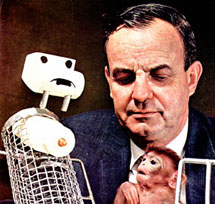
Harry Harlow
I wanted to share some of my thoughts about the Romanian children and their situation. As I've been thinking on the subject I realized that, were I to write it all down it would make for an interesting but excessively long blog post. Therefore I decided to do another series of posts leading you through my thought process. Similar to my posts on service.
Love at Good Park,
 by Deborah Blum

This past semester I read a very interesting book entitled "Love at Goon Park." It is a biography of Harry Harlow, one of the prominent psychologists in the study of affection and attachment, and probably one of the reasons why your mother held you as a child.

Before Harlow's time, in the first half of the 20th century, the world of science and psychology was charging ahead into misdirected "progress" as it so often does. Psychologists believed that a child's bond with its mother was based only on the mother as a food source, and any emotion were just conditioned responses to external stimuli. Any discussion of love or affection in child rearing was deemed unscientific, or just mushy sentimental fluff.

Some scientists, like Watson with his little Albert experiments, took this thinking too far. In more of a case study than a true experiment Watson took an infant named Albert and conditioned him to fear anything furry or white, like a rabbit. Watching videos of the process scares even me and looks like an old man just terrorizing a helpless child. However, thinkers of the day took this "experiment" to prove how children are just conditioned to do certain things. In fact, Wilson went on to write a best-selling book where he cautioned parents of the damaging consequences of love and affection.

The "Baby Tender" created by Skinner
B.F. Skinner and all of his behaviorist ideas had a thing or two to say as well. He believed that every single thing about us is a conditioned response to a stimuli. In theory  you could "condition" or "create" the idea human being with the right environment and stimuli. He took the "Skinner Box" used in his pigeon studies and designed one for children, and even placed his own daughter inside of it. It allowed for the child to be isolated in its own space and a piece of glass on one side allowed visual interaction between child and parent.

Forgive me for saying this, especially since I have the benefit of 20/20 hindsight vision, but these ideas were dumb. Especially given the evidence against it. The isolation that so many scientists were calling for was in fact damaging the children. In orphanages where children lacked the love and affection mortality rates were astronomical. Children would literally turn their faces to the wall and die from lack of will to live, which resulted from a lack of love. The children were living in deplorable circumstances.

One anecdote tells of an orphanage where mortality rates were high in all sections of the hospital...except for one. All the researchers strove to find out the difference. Diet? Peers? What was it? The answer was that when the cleaning lady in charge of that section of the hospital came in at night, she would pick up the babies and hold them while she worked.

Harry Harlow enters the picture with his monkey studies. A famous experiment of his, which is featured on the cover of the book above, is where he took infant monkeys and gave them surrogate mothers. The surrogates were made of wire and wood. Two of these surrogates were placed side by side. One had a milk bottle, and the other was wrapped in a terry cloth to make it warm and soft. Monkeys spend a vast majority of their time with the softer mother and only went to the wire mother when they needed food. This debunked the thinking that we form our relationship based on food alone, and showed instead that we need love, we need affection, that is what matters most to us.

In a Romanian Orphanage

After battling the zeitgeist of his day Harlow, and others, were able to show us just how much we need love. This was able to prevent situations seen in the hospitals and mortality rates dropped significantly. It now became a thing of the past. At least...it should have. However, orphanage situations in Romania mirror quite close to the way things were run in the early 1900's. Bridge of Love describes the situation as follows,  "Babies and toddlers stayed in their cribs nearly all day, starved for love and attention. The bedroom walls were bare, and a cold breeze seeped through the windows of the poorly heated orphanage/hospital.
               There were no blankets or toys in the room, and the workers changed the babies’ diapers in silence. The toddlers rocked their little bodies back and forth for hours, the only stimulation they could create. The older toddlers banged their heads on the side of the crib—over and over—creating a new noise and huge lumps on their heads.
               Laurie described the situation as “children living in a zoo.” They each had their own cage from which they couldn't escape. Most of the children had been abandoned at birth, with little or no information about them left behind. There were no plans for these children—they just existed."

It makes me sad when I'm reading a journal article on an attachment or rearing study and instead of some monkey experiment, the researchers were just able to go to Romania and observe the effects there. This is why I feel strongly about what I'm doing, and I'll explain further in later posts. These children need help, and we are in a position to offer it.


Monday, December 17, 2012

Kahuna Creations Magic!

Well...it has been far too long since last I posted. I apologize. After I got engaged I had to bunker down and get through the last two weeks of school. Projects, quizzes, papers, and of course, final exams. I have triumphed and made it through the storm. Thank goodness.

Chief FreeWind desiging the board aesthetics.
Courtesy of Kahuna Creations
During this time of trial and testing terror, I was shown that there is still light and goodness in this world by my friends at Kahuna Creations. In a moment of agony and studying I decided to waste a minute or two or ten and take a break. Did I take a nap, or go on a walk? No, I got on Facebook of course, where the rest of the student population was also wasting time.

I logged on, and in my news feed I saw it...a magnificent work of art. All the splendor and magnificence that can be compressed into one glorified piece of maple wood. The Black Wave. A finely shaped board which has been artistically "tattooed" by Samoan Chief FreeWind. This is an attractive looking board to be sure, but the designs and intricacies of Chief FreeWind's craft have set this board apart, not only as a great board, but as a work of art. It comes in black and clear coating.

I love the Kahuna products. They have displayed innovation with their highly useful "Big Stick". I use it every time I board. One time I went four miles without my feet even touching the ground. They have a plethora of beautiful boards and recently even got their own wheels...sick orange wheels. Up till now they have been a great company, friendly, customer oriented, active but now....with this board....they have further set themselves apart with distinction.

Nice work Kahuna, I am more than impressed. Felicitări.

I took the liberty of borrowing this picture so you can see the boards. Seriously, they look great.

Monday, December 3, 2012

Deșteaptă-te, române!

Well....I've been a little slow in keeping up with the holidays. I think I have a good excuse for missing this one. The one I want to talk about now is December 1st. A great day for Romanian history.

December 1st is the Unification Day or National Day of Romania. Kind of like our fourth of July. It memorializes the unification of Transylvania into "Greater Romania" in 1918 as well as Bessarabia and Bukovina. The unification was held during the reign of King Ferdinand I. The declaration was read at a public event in Alba Iulia where 10,000 citizens attended.

I remember being in the capital city, Bucharest, on December 1, 2010. Lots of the roads were closed and traffice was bad due to the huge parade. I was, unfortunately, unable to attend the parade, but those who braved the cold weather and snow had a grand old time.

La mulți ani România!!!

Happy Birthday to a wonderful beautiful country, with wonderful beautiful people and a wonderful beautiful heritage and language. Over this weekend I got to meet a man from Romania and speak to him in Romanian. I miss that language, it is so beautiful.

The day of December 1st will forever have special significance to me beyond Unification Day of Romania. It was also the day when I asked my sweetheart, Jamie, to marry me. She said yes. Hence why I was a little slow in posting about December 1st. I was too busy trying to surprise her.