Showing posts with label books. Show all posts

Monday, February 4, 2013

Busy Day, Empty Life

Well I finally read Tuesdays With Morrie. I've been wanting to ever since I read Mitch Albom's book Have A Little Faith. It seems like Mitch Albom is always talking to incredibly wise old men who are close to dying.  In Tuesdays With Morrie Albom has weekly meetings with an old professor and mentor named Morrie. Morrie is dying and before he goes he shares his experiences and wisdom.

This book made me think about a lot of things. One thing in particular stood out to me. In the book Albom shares an experience where he is at Wimbledon and on a high energy day he was knocked down by a rushing group of reporters and photographers as they tried to chase down a celebrity. This made Albom think about something Morrie said: "So many people walk around with a meaningless life. They seem half-asleep, even when they're busy doing things they think are important. This is because they're chasing the wrong things. The way you get meaning into your life is to devote yourself to loving others, devote yourself to your community around you, and devote yourself to creating something that gives you purpose and meaning." 

Albom expounds on his experience in England at the tennis tournament. He noticed the tabloids and headline newspapers. Alboms says, "People scooped up these tabloids, devoured their gossip, and on previous trips to England, I had always done the same. But now, for some reason, I found myself thinking about Morrie whenever I read anything silly or mindless. I kept picturing him there, in the house...counting his breath, squeezing out every moment with his loved ones, while I spent so many hours on things that meant absolutely nothing to me personally  movie stars, supermodels, the latest noise out of Princess Di, or Madonna, or John F Kennedy Jr. In a strange way, I envied the quality of Morrie's time...Why did we bother with all the distractions we did? Back home, the O.J. Simpson trial was in full swing, and there were people who surrendered their entire lunch hours watching it, then taped the rest so they could watch more at night. They didn't know O.J. Simpson. They didn't know anyone involved in the case. Yet they gave up days and weeks of their lives, addicted to someone else's drama.
          "I remember what Morrie said during our visit: 'The culture we have does not make people feel good about themselves. And you have to be strong enough to say if the culture doesn't work, don't buy it." 


The ideas that Morrie and Mitch have remind me of book I read recently, A Pilgrim's Regress, by C.S. Lewis. It chronicles the story of a man named John Bunyan as he searches for an Island. He meets many people with many ideas, but one hit me hard, a man named Mr. Halfways. Halfways brings John to his home and sings for him. During the song John has a vision of the Island, and as he is about to reach the Island something always happens that distracts him from reaching it. He never makes it, because some halfway thing keeps him from it.

I think we do this a lot in our lives. We fill it up with halfway things, things that aren't what we really want, but its good enough for now, and we settle. There are examples of this all over our lives, and Albom gives good examples from his experience at Wimbledon. Last semester I was filling my life with these halfways. I was so busy, but not very happy. Doing so many things and running all over, but never having enough time for what's important. I tried to slow down a little bit this semester so I can focus on the essentials. It has made a difference in my life. This is also one reason why I'm doing this trip. The reasons links to what Morrie said about breaking out of these halfways, "The way you get meaning into your life is to devote yourself to loving others, devote yourself to your community around you, and devote yourself to creating something that gives you purpose and meaning." 

I love what Dieter F. Uchtdorf says in this video I posted below. It is good to slow down, to take a moment for the essentials. To find what really matters, and to devote ourselves to helping others. I'm afraid that if we don't, we may have busy days, but empty lives.




Monday, January 7, 2013

Be Satisfied. Be Grateful. Be Giving

I've noticed that recently I have really had a thing for Jewish Authors. I loved Viktor Frankl's Man's Search for Meaning, and Will to Meaning, as well as his Man's Search for Ultimate Meaning. I recently read Harold Kushner's How Good Do We Have to Be? I'll read most anything by Martin Buber. I just really like these books. I realized how many of them I have been reading when I finished another book by a Jewish writer. Mitch Albom's Have a Little Faith.

I loved the book. It was a Christmas present to me from my future in-laws who enjoyed it and know I love to read. I own a copy of Mitch Albom's Tuesdays With Morrie but I've never read it. I intend to do that soon because I really like his writing. In Have a Little Faith Mitch is gives chronicles meetings with his rabbi, Albert Lewis. Mitch is preparing a eulogy for the eventual death of the rabbi and meets with him frequently to prepare.

I love the story and the fact that it's true. I really learned a lot and enjoyed Mitch's conversations with his spiritual leader. One story I liked in particular. Mitch asks the rabbi "What makes a man happy?" and his rabbi answers saying, "The thing's society tells us we must have to be happy- a new this or that, a bigger house, a better job. I know the falsity of it. I have counseled many people who have all these things, and I can tell you that they are not happy because of them.
         "The number of marriages that have disintegrated when they had all the stuff in the world. The families who fought and argued all the time, when they had money and health. Having more does not keep you from  wanting more. And if you always want more-to be richer, more beautiful, more well known-you are missing the bigger picture, and I can tell you from experience, happiness will never come."
          They are interrupted by a baby crying in the hospital and the rabbi says, "Now, that child reminds me of something our sages taught. When a baby comes into the world, its hands are clenched right? Why?  Because a baby, not knowing any better, wants to grab everything, to say, 'The whole world is mine'
          "But when an old person dies, how does he do so? With his hands open. Why? Because he has learned the lesson. We can take nothing with us." 

I think this story shows where we can find true happiness. We cannot become happy by amassing things. In fact, as Viktor Frankl says, perhaps our quest for happiness is the very thing keeping us from true joy. If we focus on receiving things and being happy ourselves we are missing the true point. I don't believe happiness is the end goal. I think it is the by product of a life well lived. It comes from thinking of others and helping. Not by taking and getting, but by letting go and giving.

Mitch Albom continues the conversation between him and Lewis.

So, have we solved the secret of happiness?
"I believe so," he [the rabbi] said.
Are you going to tell me?
"Yes. Ready?"
Ready.
"Be satisfied."
That's it?
"Be grateful."
That's it?
"For what you have. For the love you receive. And what God has given you."
That's it?
He looked me in the eye. Then he sighed deeply.
"That's it."

Be satisfied, be grateful, and I would add, be giving.

Wednesday, December 19, 2012

All You Need is Love

Harry Harlow
I wanted to share some of my thoughts about the Romanian children and their situation. As I've been thinking on the subject I realized that, were I to write it all down it would make for an interesting but excessively long blog post. Therefore I decided to do another series of posts leading you through my thought process. Similar to my posts on service.
Love at Good Park,
 by Deborah Blum

This past semester I read a very interesting book entitled "Love at Goon Park." It is a biography of Harry Harlow, one of the prominent psychologists in the study of affection and attachment, and probably one of the reasons why your mother held you as a child.

Before Harlow's time, in the first half of the 20th century, the world of science and psychology was charging ahead into misdirected "progress" as it so often does. Psychologists believed that a child's bond with its mother was based only on the mother as a food source, and any emotion were just conditioned responses to external stimuli. Any discussion of love or affection in child rearing was deemed unscientific, or just mushy sentimental fluff.

Some scientists, like Watson with his little Albert experiments, took this thinking too far. In more of a case study than a true experiment Watson took an infant named Albert and conditioned him to fear anything furry or white, like a rabbit. Watching videos of the process scares even me and looks like an old man just terrorizing a helpless child. However, thinkers of the day took this "experiment" to prove how children are just conditioned to do certain things. In fact, Wilson went on to write a best-selling book where he cautioned parents of the damaging consequences of love and affection.

The "Baby Tender" created by Skinner
B.F. Skinner and all of his behaviorist ideas had a thing or two to say as well. He believed that every single thing about us is a conditioned response to a stimuli. In theory  you could "condition" or "create" the idea human being with the right environment and stimuli. He took the "Skinner Box" used in his pigeon studies and designed one for children, and even placed his own daughter inside of it. It allowed for the child to be isolated in its own space and a piece of glass on one side allowed visual interaction between child and parent.

Forgive me for saying this, especially since I have the benefit of 20/20 hindsight vision, but these ideas were dumb. Especially given the evidence against it. The isolation that so many scientists were calling for was in fact damaging the children. In orphanages where children lacked the love and affection mortality rates were astronomical. Children would literally turn their faces to the wall and die from lack of will to live, which resulted from a lack of love. The children were living in deplorable circumstances.

One anecdote tells of an orphanage where mortality rates were high in all sections of the hospital...except for one. All the researchers strove to find out the difference. Diet? Peers? What was it? The answer was that when the cleaning lady in charge of that section of the hospital came in at night, she would pick up the babies and hold them while she worked.

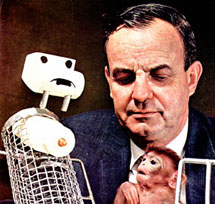
Harry Harlow enters the picture with his monkey studies. A famous experiment of his, which is featured on the cover of the book above, is where he took infant monkeys and gave them surrogate mothers. The surrogates were made of wire and wood. Two of these surrogates were placed side by side. One had a milk bottle, and the other was wrapped in a terry cloth to make it warm and soft. Monkeys spend a vast majority of their time with the softer mother and only went to the wire mother when they needed food. This debunked the thinking that we form our relationship based on food alone, and showed instead that we need love, we need affection, that is what matters most to us.

In a Romanian Orphanage

After battling the zeitgeist of his day Harlow, and others, were able to show us just how much we need love. This was able to prevent situations seen in the hospitals and mortality rates dropped significantly. It now became a thing of the past. At least...it should have. However, orphanage situations in Romania mirror quite close to the way things were run in the early 1900's. Bridge of Love describes the situation as follows,  "Babies and toddlers stayed in their cribs nearly all day, starved for love and attention. The bedroom walls were bare, and a cold breeze seeped through the windows of the poorly heated orphanage/hospital.
               There were no blankets or toys in the room, and the workers changed the babies’ diapers in silence. The toddlers rocked their little bodies back and forth for hours, the only stimulation they could create. The older toddlers banged their heads on the side of the crib—over and over—creating a new noise and huge lumps on their heads.
               Laurie described the situation as “children living in a zoo.” They each had their own cage from which they couldn't escape. Most of the children had been abandoned at birth, with little or no information about them left behind. There were no plans for these children—they just existed."

It makes me sad when I'm reading a journal article on an attachment or rearing study and instead of some monkey experiment, the researchers were just able to go to Romania and observe the effects there. This is why I feel strongly about what I'm doing, and I'll explain further in later posts. These children need help, and we are in a position to offer it.


Thursday, November 8, 2012

Make a Wish Bram Stoker!

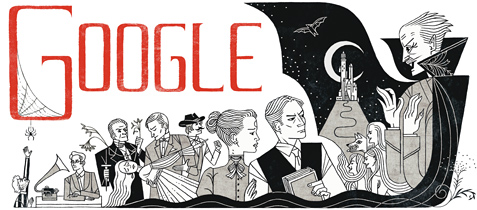
Today Bram Stoker was remembered in a Google Doodle on Google's homepage. This is Stoker's 165th birthday. Bram Stoker is best known for his still-popular novel, Dracula. I love that book. It is masterfully written. I love the format of the book. It doesn't read like a normal book, but is more a collection of journal entries, letters, and newspaper articles, which all combine to tell the story of the Vampire. It is an engaging read, and one that really scares you at times. I would recommend it to anyone. It's no wonder why it is a "classic".

Vlad Tepes,
or Vlad the Impaler
"So Mason," you may ask, "Why are you putting this up on a blog about Romanian Orphans and Longboarding? I fail to see the connection. Why Bram Stoker? Why Dracula's Dash for Hope too?" Well, I do this because the main inspiration for the character of Dracula is none other than Romanian national hero, Vlad Tepes, or Vlad the Impaler. Even the name Dracula comes from a Romanian word that means, "The Devil." Transylvania is a region in the central part of Romania. I got to live there for a while. It is a beautiful area of the world, but a little eerie on a foggy winter night.

Vlad was a very bloody ruler who helped to unite Romania. His methods were violent and often involved impaling hundreds of people till they die. The Romanians love him. Why? Not because he was so ruthless, but because he was able to hold the country together and keep the Turks from conquering. There is an anecdote that the Turks sent an army to scout out Romania before the larger force arrived. When the main part of the Turkish army reached the borders of Romania they found their scouts...but not in the condition they expected. Every soldier in the scout army was impaled on a pole and their bodies lined the road that led to Romania. The anecdote says that the Turkish Sultan was so disgusted and horrified that he vomited, and then turned his army around, leaving Romania alone.

Stories about Vlad are fascinating, macabre, and at times they can be far-fetched. My favorite, however, is Bram Stoker's story. Thanks Bram, I appreciate what you've done for us all in giving us the gift of your book.

Now...the question, do vampires exist? Were they really killed. Here are two thoughts for you to think about. In order to kill a vampire one must drive a wooden stake through their heart and chop off their head. SPOILER ALERT: In the book, Dracula is hastily "killed" with a Bowie knife to the heart, and a kukuri knife to chop off his head. This is close, but where is the wooden stake? Did it work? I believe that this is the question that led to the Dracula sequel, written by Bram's descendant Dacre Stoker. I've never read it, so tell me what you think.

Bram Stoker
Another evidence for vampires, is someone I met in Romania. We used to teach free English classes to people in the cities in which we lived. On lady we taught was about six foot three inches tall, and apparently a judo champion, very intimidating  She always wore black, with a turtleneck or a high collar. Sometimes dressed like a pirate, knee high boots and frilly sleeves with a vest. Her son was a really nice kid who was also really tall, thin and had a "goth" look. We could never tell how old she was, 29 or 50. One time we asked the class what they all did for work. Her answer, she is a real estate agent for a Count who lives in a castle in Transylvania  Sound like Jonathan Harker to anyone else. Vampire? Well, I'm not saying yes, but I'm not saying no.