Longboard for Love is a team of longboarders who wanted to go on an adventure. An adventure that could help change the world. On April 29, 2013 they rode their boards over 650 miles along the coast of California. The purpose of doing this was to raise money for the Bridge of Love, a charity foundation that helps the abandoned and orphaned children of Romania. Longboard For Love was able to raise enough for the education of these struggling children. Stay tuned for our next adventure!
A Viking helmet!
I actually don't reccomend
this for longboarding
Like I'm sure you've seen, I am a big advocate for helmets. If you are riding a board you are guaranteed to fall at some point in time. You need to be well protected. Thankfully if you break a wrist or an arm, your bones and muscles regenerate and heal. However, your brain cells don't regenerate like a broken bone do. Damage is often permanent. This may seems silly, but if our brain cells were always dying and regenerating, like skin cells or blood cells, you would be constantly forgetting and relearning things over and over. There is a method in this madness.
Since brain damages are permanent it is vital that we take care of it. In this post I want to talk about what to look for when purchasing a helmet. I am no authority on the subject and just got my information from reading and research. In the end the best thing you can do is read up on the subject and be safe.
As a younger person I didn't like to wear helmets. I thought they didn't look cool and were uncomfortable. It took a frightening crash and more information on helmets to convince me to wear one. I tried a few helmets but I ended up sticking with the basic Triple 8 Brainsaver. This is a nice helmet. It is great for simple skateboarding and longboarding. I love the terry-cloth liner inside and how comfortable it is. The model that I have, however, is not certified in any way. This means that I should not ride it on a bike, or at high speeds. It's perfect for the cruising and longboarding that I like to do. Especially good for a long distance trip.
Some of the best skateboard helmets are "dual-certified" to both the ASTM and CPSC standards. These provide much more protection for dangerous skating and bicycling.
But what does ASTM and CPSC mean? Well these are just tests that are run to see how well the helmets perform. A CSPS test is when they simulate a drop from 6 feet at a 14 mph impact. These kind of helmets are for bike riding. The ASTM test is a from from 3 feet at a 7 mph impact. ASTM helmets are made for skating. Helmets should be used for the proper activities and are not always guaranteed to prevent injury. But why take the chance without one.
In your quest for the right helmet you may hear about soft-foam or hard-foam helmets. This is just referring to the foam inside of the outer shell. This is what compresses as your head hits an object and helps slow down your head and reduce injury. A lot of helmets advertise as multiple impact, but, once again, why take the risk. After a bad crash or impact (and especially if you see damage to the helmet) you should throw it away and get another one. Small impacts you may be okay, but why gamble your brain on the $40 it takes to get a new helmet?
There are lots of different helmets out there and lots of good companies. Like I've mentioned before, my personal favorite, for the past 6 years, has been Triple 8. I like the design, and the comfort a lot. The helmets are quality and classy. Beyond the product itself Triple 8 is just a good company. I really like the forum they have where they take suggestions from people.
All that really matters though, is you get a helmet, and put it on your head when you ride. DO IT!
A few weeks ago Freya, my scooter, was damaged in a parking lot while I was at work. I finished my shift to find that someone had moved her, knocked off the mirror, and added a few new scratches. To make it even worse the scooter would not start. Therefore I was back to longboarding to get around. Carrying the big Sector Nine board around campus gets a little tiring and so I was looking for something smaller for school. I settled on a blue Stereo Vinyl Cruiser which I found for a pretty good price.
Its a nice little board, very old school, and very fun to ride around. However the stock bearings it came with were junk and wouldn't spin very fast. I replaced them with new bearings and decided to take the opportunity to explain about skate bearings.
For the longest time I had no idea what bearings were, how to clean them, or how to replace them when needed. I've decided to help out all the budding boarders and explain it now. Your board has the deck where you stand, under the deck are the metal trucks. Your wheels attach to the trucks, however, rubber wheels don't spin too well against metal. In between the wheels and the trucks are the bearings. Metal rings that have little metal spheres inside. This spins which allows your wheels to spin. After time the spheres wear out or get dirty and you need to replace the bearings.
How to Change Bearings
All you need is your board and a small wrench with which you can take the bolt off the end of the trucks.
Take the wrench and carefully unscrew the bolt off the trucks. Then take your wheel off. Be careful because there will be two small washer rings called bearing spacers, be sure not to lose them.
Carefully unscrew the bolt...
...and take the wheel off the trucks
Then, all you need is the trucks and your wheel. Angle the bearing on the very end of the trucks and push carefully on the wheel. The bearing should just pop out.
If you want to save the old bearings, for another board or just to
clean them, be very careful not to push too hard and damage
the bearings
Then you take your new bearings and push them into the wheel. They might not go in all the way just by using your fingers. Do not pound on them to make them fit better! Instead, put the wheel back on the trucks and tighten the nut as far as you can and this will push the bearings in all the way. Then loosen the nut until the wheel can spin freely and wiggle a little bit on the trucks. You have just succeeded in replacing your bearings. Congratulations. Its not too bad is it? But if no one every told you, you would have no idea. Now get out and ride on your board, after an hour or so the bearings should be broken in enough and spinning beautifully.
Unforgiving rock hard asphalt. Covered in little gravel pebbles and tar. 20 grit sandpaper surface. This is what is waiting to welcome you if you fall off your longboard. This is not a welcome most wish to have. Longboarding can be a very fun sport, but if not done safely it can cause serious injury or even death. One thing to keep in mind is that the faster you go, the harder you fall. Therefore it is paramount that you keep your speed in check.
If you get going too fast not only does your danger level build, but you may experience the dreaded SPEED WOBBLES!!! (Dun dun duuuun). At certain high speeds and with certain board set ups, your board will start to uncontrollably pitch from left to right and eventually throw you off. Take this poor sad man for example. He had a bad case of the speed wobbles, and the lucky guy was stupid enough NOT to wear a helmet. Bad decision every time! He's lucky he missed the car and made it to the grass.
I remember my worst case of the speed wobbles. I decided it would be a good idea to put my longboard trucks on my skateboard. Then, stupid and without a helmet, I decided to bomb a hill. I was surprised at how sharp my turns were on my board. However I forgot that the shorter the board, the less stable at high speeds, and soon my carving turned into wobbling. The full force of my stupidity hit me and I wondered what to do. I decided to bail before I got going too fast. I jumped off my board...took two running steps...tripped...did a flip....landed on my back and rolled four or five feet where I came to a stop on the curb of the road.
I lay there bleeding, groaning and wondering why I ever did something so dumb. My little brother came racing by me on his board, "Mason! Are you okaaaaaaaaaaaaaaaaaaaaaaaaaayyyyy!!!!!!!!!!" And he shot right by me as I lay there in the road. I eventually pulled myself off the curb and onto the grass and waited for my brother to come save me. Five or ten minutes later he returned and was somehow surprised, after my ragdoll asphalt acrobatics, that I was still laying down. He took me home and I was fine except for some roadburn and bruises. I am lucky beyond all reason that I didn't hit my head. When I flipped I really should have slapped my forehead on the ground. I got a lucky chance, and I've always worn a helmet ever since.
I can tell you from experience, check your speed, stay in control. Going fast is fun, you do look cool, until you hit a rock and go flying, or get speed-wobble-thrown and get all cut up. Controlling your speed is one of the first things you should learn.
"Mason, hold on a second," you may ask me, "there are no brakes on a longboard. How on earth can you control your speed. "Good question," I respond, "there are a few ways. Lets talk about them."
Ride It Out or Bail
If you feel confident enough you can just have faith and keep riding until your board slows down. If you're on a hill that levels out at the end you may be able to hold fast and ride it out. If you feel uncomfortable my advice is to bail before you get going too fast. Jump onto some grass. The sooner you get off, the slower you'll be going, and the risk of injury is minimized.
Skidding
If your board has a kicktail you can push it down to the ground and use that as a brake. I would suggest getting a tailguard if you prefer this method or else the road is going to eat up your board. To be honest I would not suggest this method of slowing down. Lifting your two front wheels off the ground while going at high speeds is not the brightest or safest idea.
Sliding
A fun but more expensive way to slow down is to slide. Basically your board goes perpendicular to your direction of motion and your wheels slide sideways on the road and you slow down. Its fun, and it looks really cool. I suggest looking up some videos on how to do this. It can get a little pricey because it causes damage to your wheels, causing flat spots that bump as you ride, and sliding-gloves are recommended as well. This can add up. This video below shows some pretty cool slides as well as some impressive footwork.
Carving
Turning your board from one side to the other, or carving, will slow you down. The harder you carve the more you decelerate (my physics teacher would hate that I just used that word). This is a lot of fun for riding and a preferred method of braking. Carve those hills! My one word of advice is not to play "Chicken" with the curb because you lose every time, the curb won't move out of the way, and Bonnie Tyler will not sing about her hero.
Windbraking
If you are going at a speed of 25 or more miles per hour you can stand up and spread your arms, pull your jacket out wide, just do everything to create as much wind resistance as possible. Certain companies sell "sails" you can buy, the problem is that wind conditions have to be near perfect, and one crash will tear up the "sail" material. Windbraking won't stop you but it may slow you down just a bit. There are still better methods however.
Brakes on Your Board
Some companies do make brakes for your board. I'm not sure how well they work but they look cool. You can check them out here Skatebrake.com and Brakeboard.com.
Foot Braking
Besides carving this is my preferred method of braking. Basically you are dragging your foot on the ground and this slows you down. This can bring you from high speeds to a standstill if you want. You need good balance because what you do is take your back foot (or whichever one feels most comfortable for you) and you drag it on the ground. Start by putting the front pad and toes on the ground and slowly lower your heel down and try to apply pressure using the whole surface of your sole. As you can see from my earlier post on shoes, this does eat up the sole of your shoe. However, I think its better to have asphalt damage to your shoe than your face. This is why I recommend going with a cheap pair of shoes, a pair you bought specifically to trash. Practice foot braking because, in my opinion, it is the cheapest and best way to slow down.
Kahuna Big Stick
An ingenious idea of a "paddle" for riding was used by Kahuna Creations. It is basically a paddle handle on one end of a stick and vulcanized rubber on the other end. This is primarily a propulsion device, but it can be dragged on the ground to slow you down. It is a lot of fun to use for pushing forward or braking, I would suggest anybody getting one. Dragging it for braking does cause some wear on the rubber but you can buy replacements for pretty cheap.
Now that you know all of these methods, get out and practice them. They will make you a more dynamic rider, and really increase your fun when you aren't falling and getting injured all the time. Most important though, WEAR A HELMET!!! Safe speeds and safe riding is no substitute for a good helmet. You can go brain dead moving at five mph or fifty. Wearing a helmet is your best tool to minimize injury. My personal favorite are Triple 8 helmets, and I'll explain why later, but just get some sort of lid on your head.
What shoes to wear? Thats something I've been wondering about as I train. To be perfectly honest I've never really had nice skateshoes. I figure, why do I want to buy something that I'm just going to quickly trash. I usually just buy a pair that fits nice from a thrift store. My last pair were given to me by my brother. Just a no-name brand pair. They have been working pretty well.
When you're boarding you want a pair of shoes that has good grip. A good sole is important too because of footbraking. As you can tell from my pair, they are terribly worn down from braking. You can plainly see that I need a new pair of shoes. I also need to learn how to footbrake with my left foot too. That will double the life of my shoes.
The sad effects of footbraking.
My last pair of shoes.
Just a no name brand. They worked
well though.
Skate shoes are great for normal skating. For distance-skating thought, they are no bueno. They're too heavy. Have you ever heard the old hiking adage that a pound off your shoes is equal to five off your back? Skate shoes don't breathe at all. They are thick, they're padded, they're comfortable, but your feet roast in the summer heat. They also have practically no support. I need shoes that are breathable, light, Good support, with a tough sole.
I'm going to be experimenting with different types of shoes leading up to the trip. My recent pair is everything I've decided I need. I bought a shoe/sandal hiking shoes on sale, perfect for me to trash on my board. Here is a picture below.
As you can see these are very breathable, it is covered in holes. It is very light which helps a lot, especially for my knees. With a heavy skate shoe on the end of my leg it put a lot of strain on my joints when I would swing my foot to push. It is also interesting to ride with a hiking shoe sole as shown below.
The sole is tough. It provides a lot of forward push because hiking shoes get tons of traction. There is a thin layer of rubber though and then some softer material that the road will eat right up. I hope the rubber lasts for a while, or I'll be doing Shoes: Experiment #2 soon. I really do enjoy these quite a lot. I used them for my 6:00 am ride this morning and they are really nice.
My Physics Proffessor and I
I've had the chance to go longboarding with some friends of mine recently. Most of them have either no experience or very little experiene longboarding. Each time I've assured them that I'll help them figure it out. That has been harder than I thought it would be.
Now is is no fault of my friends, the problem lies with the teacher. I've been longboarding for eight years now, and thats only part of my board sports. Snowboarding, skateboarding, wakeboarding, I even tried mountainboarding for a few months. I have found that, like my Physics 105 professor who is thinking far above the beginner student mind, the material has become second nature to me, a part of me. I have a hard time believing someone cannot simply stand on a longboard without falling down.
A moving sidewalk. Which does not usually change
speed or pitch to the left and right.
"Pretend like you're just standing on the ground," I told my friend about the longboard, "except the ground is moving and tilting. Like a dynamic moving sidewalk." "Mason," He replied, "that doesn't make any sense." and to my surprise it hit me that something that made so much sense to me, was in reality, complete gibberish.
Therefore, I have decided to begin posts about Longboarding helps. Things I wished I had known back when I was kicking my wheels as I pushed, losing my balance all the time, or wondering, as I was shooting down a hill which was far beyond my skill level, where on earth the brakes are. Well, lets start at the beginning .
What is a longboard?
A longboard is basically a glorified piece of wood (the deck) attached to two metal pivots (the trucks) which are attached to wheels. Between the wheels and the trucks are what we call the bearings, these are little metal rings within which are small metal spheres. This is what allows the wheels to spin. There are many different kinds of boards created for many situations, but I'll cover that later.
This is your basic Sector 9 cruising longboard. About 46" long. Kicktail, camber, etc.
How to ride a longboard? In an earlier post I explained how to find out your "footedness". Once you have determined this you are ready to ride. I would begin on a small hill. Walk to a safe distance and step onto the board. Ride down and practice turning. This is done by learning on way or the other, toeside and heelside. Once you feel comfortable with this you can now begin pushing.
Longboarders on a slow hill in
Provo Canyon
Take your front foot and either leave it sideways or turn your toes to face the front of the board, whichever is most comfortable. Now, take your back foot and push off the ground with it(this can be done in reverse with the back food on the board and the front foot kicking. It is known as "mongo"). Remember that your weight should resting on the foot that stays on the board. Try not to shift your weight too much towards your kicking foot. This may cause the board to get ahead of you which will cause you to fall backwards. Really the most important thing is to stay loose, bend your knees. Don't think about it too much. Viktor Frankl calls this hyper-reflection which means, thinking too much about it distracts you from letting it happen. Just have fun. Don't worry what everyone else thinks. Don't bother yourself if anyone is better than you, they had to start from zero once too and they have the scars to prove it. Also, if you fall down, get back up and try again(unless it is physically impossible for you to get up. In which case I would have you or your friends call 911 and once you are healed I would get back on the horse and try again as a wiser, smarter rider), MOST IMPORTANT, wear a helmet, please. Well, have fun. At a later date I'll post about different types of boards, how to stop, how to change your bearings and other neccesary information. Until then, have fun riding.
This long trip is going to need a lot of equipment. Backpacks, tents, low-riding longboards, etc. Sometime soon I'll post a list of everything I'm taking with me. A lot of these things are expensive. In preparation for my trip I have been liquidating my boards for additional funds (speaking of which, if anyone is looking for a good mountainboard I'm trying to get rid of mine). I don't need three boards, I just need one. Just a few days ago I sold one of my longboards to a friend. This wasn't just any board, it was my very first longboard I ever had.
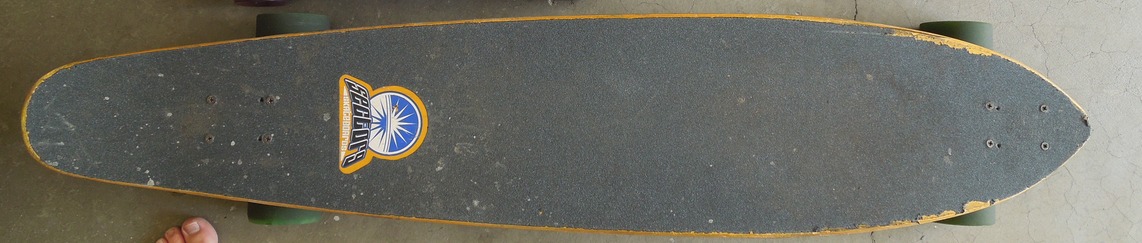
My first board was a Krown. Krown is not a high end longboard company by any means, but it is a perfect beginners board, especially for the price. Her name was Roxane, I don't know if I got that from Cyrano de Bergerac or the song by the Police but it just seemed to fit. I had Roxanne for years and years. The nose of the board was chipped from when I hit a car, the flat deck was a little warped, but I loved her still.
I never spent time with Roxanne except for carving down big hills, like I said, Krown is a good beginner board and I have since moved on, so she spent a lot of time on a shelf. That is why I am happy to see her go. My friend is just getting into longboarding and Roxanne is the perfect beginners board.